
“Last night’s spangles and yesterday’s pearls are the bright morning stars of the barroom girls.”
–Gillian Welch, Barroom Girls
Little girls don’t dream of growing up to become barmaids, and Lori Thompson was no different, but now she stands behind the bar at The Bluff, staring into a daydream of neon-lit smoke, while men and women hover close over drinks she’s poured them.
The bar is dark, the only window in the place boarded over with plywood and covered in plastic. A small space heater run on an extension cord glows orange on a shelf behind the bar to make up for the aging furnace. Roger Price, the bar’s owner, sits leaning back in a wooden chair, reading a worn paperback. His thick white hair is combed through with pomade, making it the color of iron. Down the bar two men sit with beers in front of them, their eyes sagging, their shoulders nearly touching. They stare up at the tv hung in the corner where men in camouflage hunting gear hold scoped rifles and the antlers of a dead elk on the side of a mountain while thick snow falls around them.
“What’re you reading?” Lori says to Roger.
“Oh, hell, it’s one of those romance books like you see checking out of the grocery.”
“What got you started on those?”
“I just picked one up and took it home. Wasn’t long after my old lady left, so I didn’t have a whole hell of a lot to do. But since I took them up, I’ve had more sex than I’ve had in the last ten years.”
Lori sips from a white porcelain coffee mug. “I’ll bet.”
Roger sits back in his chair and crosses his legs, holding his place in the book with his thumb. “Well, think about it. Who reads this stuff—women. Why—because it’s what they dream of. So once you figure that out, you got something.”
Lori starts to ask him what it is that women dream of but figures it best left alone and steps around the bar to wipe down the tables along the opposite wall in preparation for the four o’clock rush when people start getting off work. A woman comes out of the ladies room and sits in front of an ashtray overflowing with crushed butts. Her makeup is smudged black around her eyes, and she dabs them with a fingertip, keeping her back to Roger the whole time. Lori walks over, dumps the ashtray, and sets it back in place. In the dim light of the room, the woman looks not much older than thirty, but the skin on her hands is loose, the veins dark and broken. Her hair runs long and straight down her back, dark and without shine.
“What’s the matter?” Roger says to her.
“Nothing.”
“Don’t look like nothing.”
“Well, it is.”
“It’s Darrell, isn’t it.”
The woman doesn’t answer.
“He don’t treat you right, Deb. He never has. And if he were here, I’d tell him that. I’d tell him he was a damn fool. Because if I had you, if I had one goddamn night with you, I’d treat you like a goddess. Like no other.”
The woman turns and looks at Roger, and he smiles at her softly. She begins to cry again and wipes at her eyes, but then stops and stands looking at him. “Thank you,” she says, and hurries back to the ladies room.
Roger holds up his book in Lori’s direction and thumps the cover with the back of his hand. She shakes her head with a mild disapproval, but he winks at her, and she can’t help but smile.
Her mother had taught her early about the ploys of men, hoping to avoid what she considered to be the curse of women in their family—both Lori’s grandmother and mother conceived their first child out of wedlock—so she told her that sex was no real pleasure in life, that it only led to the pain of childbirth and the sacrifice of motherhood, and the sooner she learned to live without it the better. When Lori bought her first pair of heels to wear to the eighth grade dance, her mother sat at the kitchen table while Lori walked back and forth across the linoleum for hours until she could do it without waggling her ass, but even with her mother’s constant pressure, she found herself pregnant a month before her nineteenth birthday.
Of course, both her grandmother and mother were married before they started showing, and their husbands worked hard—her grandfather as an oilfield mechanic, her father at the powerplant—to support their families and fulfill their duties. But Lori hadn’t had that fortune.
She was still living at home then, going to the junior college with hopes of transferring to study social work. Her mother said, “you better find a way to stay in school because you’re the only one taking care of that baby.” And her advisor showed her programs for working mothers and different financial aid forms and told her it would be tough for a few years but that by doing so, she would be able to provide a good life for her daughter and herself. And Lori knew they were right, yet she never enrolled for the next term because she came to believe she wasn’t one to be counseling others, that she was a failure as a woman—an unmarried unemployed uneducated too-young mother still living under her parents’ roof; the very thing her mother had warned her about happening; another statistic for backwater Matin County Illinois.
Lori got a job at the Ben Franklin in town—working the register, cleaning, learning how to frame and matte pictures—but when she spoke to the owners about a maternity leave, they went on about how business had been slow and that they needed to find ways to cut back and that she could work until the baby was born, but after that she wouldn’t be needed.
In the fall, a little girl was born, and Lori named her Sierra and for a while was glad for her parents’ help: her mother there for night feedings and colic and laundry; her father with an endless supply of funny faces and rocking chair stories. But as the months passed and the family eased into a routine, Lori felt the balance shifting, felt the lives of daughter and granddaughter melding as her parents treated them more like sisters born twenty years apart.
Just after Sierra’s first birthday, Lori knew she had to get out, so she applied to work at nearly every place of business in town, and she filled out paperwork for income-based housing in a new complex that had been built the year before. It took two months for her housing approval to process, and the only job callback she received was from the Bluff. She worked there every night but Monday and Tuesday while her mother kept Sierra, and since she had no real expenses, she was able to save back a first and last month’s rent deposit and was ready to move in the day after they called saying there was an opening. As her father was carrying the last of her things into the apartment, Lori smiled and told her mother that she felt she was finally getting things under control. Her mother smirked and said, “Well it’s good to know the solution to all your life’s problems was learning to flirt and pour drinks, getting on WIC, and finding place in the projects.”
“I’m trying really hard, Mom. It’s only temporary.”
“I’ll bet you thought it was only temporary when you were out slutting around town, but that little girl you got ain’t temporary, so you better get your act together.”
Lori wanted to say, You had it figured out, didn’t you Mom, staying at home cooking and cleaning like a good little woman should, having three kids by the time you were 22 so that you didn’t have to think about your own life, just had to tell us how to live ours, but instead she went over to where Sierra played in a small square of grass between the sidewalk and the parking lot and said with a great smile, “Come on, sweetie, let’s go up and see your new room.”
***
Roger is sitting at one of the tables, talking to the woman Deb, their hands nearly touching between their empty drinks. When the hunting program ends, one of the men down the bar turns off the tv, then takes up his stool again. He slaps the man he sits with on the back.
“So what’s on that test you gotta take?” He is short and chubby, his cheeks smooth and shiny.
“Fractions.”
“Do you know math?”
The other man sits with both hands on his beer glass. “I’ve worked as a paramedic for eight years. Took the test for that job at the county hospital. It’s all decimals. Not a goddamned fraction on there. Now the city thinks we need to know fractions.”
“Fractions is easy.” The chubby man takes a pencil and a napkin and starts writing figures down, while the other man looks over his shoulder intently.
Lori wipes through drops of water on the bar with a white rag. As she passes, she hears the chubby man say, “See, point twenty is one fifth. Twenty hundredths makes two tenths makes one fifth. Got it?”
“No,” the other man says. “One thing this country fucked up on was not using the metric system.”
The door opens and the light from outside is blinding. A tall man in his fifties steps in and shuts the door softly behind him. Lori turns and walks to the shelves of liquor and begins mixing whiskey and 7up. “How you doing today, Sweetwater,” she says to him.
The man takes up his seat at the bar. “Any better and I’d have to be twins.”
Lori sets the drink in front of him. “Hard day?”
“Oh you know, through rain and sleet and dark of night.” He takes a long drink.
One of the men from the other end of the bar yells over:
“Sweetwater, how’d you get a cushy job delivering the mail, while the rest of us have to work for a living?”
He holds his glass toward them in a mock toast. “I passed the Civil Service exam.”
Lori fills a small sink with water and begins washing glasses, setting them out to dry. Sweetwater lights a cigarette and says to her, “How’s a nice girl like you ever expect to find a decent man working in a gin palace like this.”
“Well, Sweetwater,” Lori says, “you’re in here everyday.”
“Yeah, but I ain’t looking for a decent man.”
There was a time when Lori thought she had a decent man. Nathan Barnes worked as head of sales in his father’s office supply business uptown, and he took her out for nice dinners in Evansville and bought her little gifts, even let her drive his brand new Mustang convertible to the college a few times while she left her mom’s 78 Malibu parked behind the store, and as she drove it proudly through town with the top down, her mother’s voice rang in her head: Honey, you can marry them rich the same as you can poor. But he had never promised her anything, never said it outloud, though many times when they were parked along the floodplain on the front side of the levee, watching the faint lights of cars passing on the bridge above them, he talked about marriage and kids, and she imagined herself in the role of wife and mother and before long began to believe that’s what he was saying.
Then she saw his picture in the paper with another girl on his arm, blonde and tan with pencil thin eyebrows and her left hand thrust forward to show the diamond on her finger. Lori drove to his parents’ house, and Nathan’s father told her that he was out playing golf, that he’d probably come home around dark, but instead of waiting, she drove to the golf course and sat in the parking lot near the ninth green, thinking she might see him, and when she did, she walked out onto the finely cut grass, waving to him. He was with two other friends, and he took her aside and whispered harshly under his breath.
“Couldn’t this have waited.”
“I saw your picture in the paper.”
“What about it,” Nathan said. His friends stood near the cart, drinking beer, their heads leaned together.
She started to wonder why she’d come here, why she couldn’t have simply accepted what she already knew. “It just seems a little quick.”
“Not really. I met her last year in Texas. We’ve been engaged for six months.”
“So I was just someone to pass the time with.”
He looked above her head toward the road, started to speak, then stopped with the first syllable so that he sounded like a child trying to sound out a word he recognized but couldn’t say. He stood with his golf club resting over his shoulder and said softly, “Kelsie’s mom and dad are shelling out twenty grand for the wedding, plus a honeymoon to Cancun, and her dad has offered me a job with his company.” He smiled as if he’d forgotten who he was talking to, let his excitement slip just a moment. “He owns a truck accessory shop. Camper shells, tonneau covers, light bars, lift kits. It’s huge.” He turned to his friends standing at the cart, and they all nodded, and one of them held down his two middle fingers with his thumb in a heavy metal salute and said, “Hell yeah.”
Lori stood with her arms crossed in front of her chest and said deadpan, “Well, how could you pass that up? In line to be the next Muffler King of East Texas. It’s a no-brainer.” She was breaking apart on the inside, but all she showed was hardness.
Nate said, defensive, “It’s accessories. Not mufflers.”
“Excuse me, your highness.”
That was all she had left, middle school comebacks, and turned away. Nate called her name, and she stopped to see him standing with both arms outstretched, teeth showing in a smile that held nothing but spite.
He said, “What’d you expect, sweetheart,” and could have left it at that, but decided to dig deep. “There are girls you marry and girls you fuck.”
Lori felt like throwing up and made herself walk to her car, even though she wanted to run sobbing with her face in her hands. She pulled from the curb, passed the city pool, then sat for nearly five minutes at the stop sign where Park Road crossed College Drive until a car moved up behind her and honked. She screamed and floored the pedal, never letting up until she realized she was doing sixty on a residential road, tears running down her face in black streams of mascara. She pulled into the tennis courts behind the college, shut off the car, and stared at herself in the rearview mirror until she was blank of all emotion. She told herself she could handle a broken heart, said it over and over, and in the following days came to believe it. And then she missed her period.
***
Lori finishes washing the few dirtied glasses and puts them away under the bar, leaving one out in front of Sweetwater. She makes him another drink and pushes it toward him, taking away his empty in a single movement. A few more patrons come in, two city workers and a woman who is a clerk at the water department, and Roger walks to the other end of the bar where they sit, pours their drafts, and starts a conversation. Lori wipes down her end of the bar, which is empty now, except for Sweetwater.
“So do you have big plans tonight,” she says to him.
“You’re looking at it. Only I hope I’m a lot drunker by the end.”
She smiles at him, thinking it was a half-joke, but he isn’t looking at her. She stands for a moment, listening to the furnace’s blower slowly crank up, then starts to walk away to the other end of the bar where the hum of people talking and laughing grows louder. But as she walks past Sweetwater, she feels his hand on her arm.
“Two years ago tonight, my son died.” His grip is strong, almost hurting her wrist, but he doesn’t realize this. His eyes hold no malice, only pain.
“I’m sorry,” she says. Then after a short pause: “How did it happen?”
He drains his glass, leaving only the whiskey soaked ice, and says, “That’s the real shitter of it all. He wanted to join the Marines, and I told him he better make no mistake about what they do for a living. Well, he went on about serving his country and about me being at Khe Sahn and this and that, and I told him, if I hadn’t been drafted, ain’t no way in hell I’d volunteer for that shit. The only thing I did to serve the country was duck my head for damn near three months, thinking it would be over once the shrapnel hit my brain. My luck just held out longer than the gooks.”
Lori stands looking sad and confused, trying to figuring out what war Sweetwater’s son could have seen. She started to ask, then thought it was a dumb question. Sweetwater didn’t seem to notice and kept talking.
“He joined up right after graduation, did real well in his training, kept a head on his shoulders, wasn’t some gung-ho idiot, and I began to think maybe he’d done the right thing. Then in ’96, he was part of the outfit sent to regain control of the Liberian embassy. It was a small action. Most people probably don’t even remember it. But when he came home, he had a really hard go. He tried to talk to me about it. I Guess when they went in, most of what they were up against were little kids with AK-47's, which never set right with him. They would have killed him. He did what he had to do. But saying it that way doesn’t change what happened. He finished out his enlistment, but was drinking pretty heavy by then and had come close a few times to getting kicked out. I tried to step in as best I could without making him feel worse than he already did. But after a few months, it seemed like he’d started to get things together a little, at least on the surface; he even talked about going to college, getting something worthwhile out of the situation, and then one night driving back to his apartment, he was going through some road construction where they’d taken it down to one lane over a bridge—it wasn’t late, there weren’t any other cars, and the autopsy showed he wasn’t drunk. He just lost it.”
Sweetwater holds his palms up, shaking his head. “The paramedics said he died instantly, but I don’t know if they just say that so you don’t think they suffered or if it was really true.” He looks up at Lori, pushes his glass toward her with one finger, and tries to make a smile. “You think I could get another?”
She nods and says, “Sure thing, babe,” then takes the bottle down and mixes his drink heavy. For a moment she feels like crying. Not for his son, though she’s saddened by the story, but for Sweetwater. From the day she met him, she didn’t believe he could ever be beaten by anything, and yet here he sits, his eyes red and bleary, his face heavy and aged by grief.
She places the glass in front of him and says, “I’ll be right back,” touching the back of his hand lightly with her fingertips. “You be okay for a minute?”
He changes his voice, trying to sound more like his usual self. “If the whiskey gets low, I’ll just reach across and pour my own.” Then he squeezes her hand, lifts it to his lips. She smiles and walks through the kitchen to the back entrance and pushes open the heavy steel door. Even with the gray half-light of late afternoon, she squints after being in the dark of the bar.
She perches herself on an iron railing along the walk and dials her cell phone. The wind cuts through her clothes, and she realizes it has snowed, though nothing more than a thin powder over the surface. Her friend Shauna answers on the third ring.
“I know everything is fine,” Lori says into the phone. “I just needed to check.”
The sound of the television plays in the background. “Sure thing, girl.” Shauna’s voice is light, indicating her smile. “We’ve eaten and now we’re watching Mulan. No problems.”
Not long after Lori moved out on her own, she became friends with Shauna Palmer, a divorced twenty-three-year-old cosmetologist who lived in the apartment across the hall, and one afternoon, while Shauna was coloring Lori’s hair at her kitchen table, she offered to keep Sierra at her place overnight so that when Lori came home from the bar at 3 am, she could sleep late into the morning and yet be close by if Sierra needed her. It was the final step of independence from her parents, and she accepted on the spot.
Lori lights a cigarette and says, “I just needed to call.” Bits of grass sticking through the snow shudder with the wind.
“You doing okay?” Shauna says.
“As well as can be expected. Tell Sierra goodnight for me, and I’ll see you in the morning.”
Lori hangs up and stands for a moment, watching an endless black cloud of starlings overhead, seeking roost for the night. The trees along the riverbank are already full with them, as if the limbs had budded a pestilence, and the world becomes quiet, nothing but the hush of a million birdwings, the scratch of the snow blown against the building.
***
By last call, Sweetwater has reached his goal of oblivion and sits hunched on his stool while younger people crowd to the bar to order drinks. Lori has been watching him all night, always sure to ask him how he is, and in the midst of the loud music and drunken laughter, he never fails to meet her eyes and smile sweetly.
As the bar begins to clear out, Lori leans in close to his ear and says, “Hang around a minute. I’ll take you home.”
The hardest thing about her job is coming home to an empty apartment. When she was a little girl, she always hated being in empty places without the noise of some human presence other than her own. On the worst nights, she goes home with some young man who’s sweet or handsome or just quiet and alone, and sometimes she sleeps with them, though she doesn’t always have sex with them, and then she awakens early and checks their wallets for whatever money they have leftover from drinking and takes what she can without cleaning them out completely.
She doesn’t see this as stealing or whoring but as taking a tip, no different than the money she’s taken across the bar all night. And least that’s what she tells herself. Deep down, she fears that it’s some kind of warped act of vengeance against Nathan Barnes and any other man that sees her as a girl to fuck and nothing more. She keeps this money in an empty coffee can in her freezer, one hundred eighty five dollars so far, and tells herself when there is two thousand, she’ll pack up everything and take Sierra from this place for good.
At five minutes till closing, Roger tells her to go on home. She walks out the back entrance to the parking lot where Sweetwater stands leaning against the fender of her car, smoking the last of a cigarette. He says in a clear voice, “I’m fine, really. I left my car at home and walked up here.”
“Well what are you doing standing around out here in the cold for.”
“I guess if something were to happen to me, I’d be an unsettled ghost knowing it was on your conscience.”
“Just get in the damned car.”
He tries to open the passenger’s door but it won’t budge. “You got me locked out, darlin.”
She climbs in and reaches across the seat to pull the handle. He sits slowly, hanging onto the top of the door as he lowers himself against the cold vinyl seat, and she turns the key. Streetlights shine through the layer of snow on the windshield. Their breath fills the car. She clears the glass with the wipers and backs out of the lot.
They don’t speak other than Sweetwater’s brief directions to where he lives, and soon she pulls in front of an old shotgun house near the railroad tracks that cut through town. He opens the door, and Lori says suddenly, “Can I walk you in?”
He sees this as nothing but concern for a drunken old man, but the truth is she’s not ready to be alone. They walk through the front door of his house, and Sweetwater flips on the lights. The front room is bare, save for a couch and a small tv set on a coffee table. She’s surprised at how neat the place is, though it’s obvious a single man lives here: magazines in a stack beside the tv; a large ceramic ashtray on the floor with a few filters lying amongst the ashes; dust over everything. An open doorway leads to the next room where a single bed sits pushed against the far wall opposite a wooden dresser. Past that is the bathroom and then the kitchen. True to it’s name, a gunshot would sail through the front door and out the back without touching anything.
Sweetwater walks slow, reaching a hand out for steadiness, his eyes barely open. Lori takes his arm and guides him through the doorway to the bedroom and helps him sit on the edge of the bed. He looks up at her and manages a smile, then eases down on his side, using his elbow to support his weight.
“Do you want your boots off,” she says.
“You don’t have to do this.”
He closes his eyes and his breathing becomes even, as if he’s fallen asleep in that instant. She waits a moment to see if he’ll awaken, but he doesn’t stir. His boots are laced to the top and double knotted. Lori tries to undo them gently, but she becomes frustrated and tugs at the laces until finally they come loose. When she slides them from his feet, she expects the smell to be overwhelming, but to her surprise it’s not. Just boot leather, a faint smell of sweat. She sets his boots together near the closet and then digs around until she finds an old quilt folded in the bottom drawer of the dresser. She covers him, pulls a chair into the room from the kitchen, and keeps vigil as one would over the sick and dying.
A sound like rocks being dropped on the roof grows loud, and she says to herself, “Snow’s gone to ice.” After a while, she goes to the front room and smokes a cigarette on the couch, crushes it out with the others in the ashtray. Then, without wanting to, she falls asleep.
When she awakens, the sky has lightened, though the sun won’t be up for another hour. She smokes again, trying to wake herself up, then leans against the arm of the couch and dozes until the sunlight coming through the window forces her eyes open.
Lori stands and looks out, a hand-edge flat against her brows. The trees and powerlines and eaves of houses look as if they are encased in glass. The chainlink fence running along the sideyard seems made of spider’s webs. Tree branches like black blood running through veins of crystal.
She puts on her coat and steps back into Sweetwater’s room. For a moment she can’t tell if he’s breathing and stands listening like she did for the first months after her daughter was born, longing for a cry so she would know the baby was alive. Finally, Lori moves beside the bed and puts her hand on his back. It’s warm, and soon she can feel the slight rise and fall of his breathing, and then without a thought, she tucks the stray strands of hair at his temple behind his ear and rises to go.
When she crosses the threshold into the living room, he speaks hoarsely:
“In the box, on the dresser.”
She turns, startled for a moment, and sees his face above the cover, nodding toward the opposite wall. She walks over to the painted wooden jewelry box sitting on the top of the dresser, which she assumes had been his mother’s, and opens the brass hinged lid. Inside is a plain white envelope with the word Savings printed in ink on the front, thick with money.
She goes to the bed and lays it beside him, but he reaches out and takes her wrist gently.
“I don’t need it.” His eyes are dark and clear. “You do.”
She steps back. “I can’t.”
“You’re a beautiful girl, Lori, but there’s more to life than what you’re living.” He raises the envelope and holds it there until she takes it. She can’t look him in the eyes any longer and turns her head toward the front door.
“Now listen,” he says. “You take that, and you do more with it than just pay the cable bill or buy your little girl some new clothes. Seems to me it oughta get you a good start on finishing up your schooling. I know other things seem more important right now, but your daughter won’t remember what you buy for her now. She will remember what her mama does for a living.” Lori starts to cry and turns to go, but she stops in the front room. His voice comes from behind her, low and calm. “I know that was hurtful. I don’t mean for it to be. But I want to say this to you, because I feel there won’t be another chance.”
She goes to speak, but her voice cracks. She clears it and wipes her cheeks. “You’re right, Sweetwater. But it’s pretty goddamned harsh.”
“I know it is, honey,” he says.
She waits to hear him rise from the bed and come to her, wants to feel his arms slide around her, but they don’t. It seems a long time before he speaks again.
“They told me that my son’s death was an accident, but I’ve been around too long for that. You never want to believe how much people lie to you, even the ones who love you. That was no accident. I know how he was feeling, been through it, and still I couldn’t say or do anything for him. He saw that concrete bridgeside, and he knew exactly what it would take. They said he was going full speed when he hit. There were no skidmarks.”
She feels cold standing in the bare room, even in her coat, and suddenly wants to leave.
“I need to get home,” she says without turning around.
“Take care of yourself, Lori. And don’t waste your worry on me. You’ve got too much living ahead of you for that.”
She opens the front door and the cold burns her lungs. She half expects him to say more before she goes out, but he doesn’t, and she shuts the door behind her. A few starlings walk across the ice-crusted snow, pecking into the surface for food, and a cardinal sits in the branches of a forsythia bush at the corner of the house, bright against the colorless world. The wind stirs the frozen trees, and she thinks it sounds like bones rattling.
Inside her car, as it’s warming up, she opens the envelope and counts the money. Thirty-three hundred dollars. She looks back toward the house and tells herself she can’t keep it, then closes the flap and puts it in her purse. She backs into the road and tries to pull away without spinning the tires, but they slide easily on the ice, so she lets off the gas and feathers the pedal until the tires grab, and she drives toward her apartment thankful the sun is rising behind her so that she can see.
***
When she walks into the Bluff that night, the place is already beginning to fill up. She scans down the bar, looking for Sweetwater, but doesn’t see him in his usual place. Roger makes a motion with his head as he mixes a drink, letting her know she’s needed right away. Then he smiles as if out of pity and looks away. She doesn’t pay this much attention and quickly gets to work behind the bar, opening beers, making drinks, picking up empty glasses.
An hour passes before she has time to notice that Sweetwater still hasn’t come in, and she begins to make excuses for him: maybe the mail was heavy today, or he had car trouble, or because of the tough night, he got a late start.
A man at the far end of the bar waves his arm at her and whistles. “You think I could get a drink down here, or should I do it myself.”
She doesn’t answer, only reaches into the cooler and pries the cap off a bottle. As she approaches him, she hears his conversation with the man sitting on the next stool, the paramedic who was worrying over his exam the day before.
“I wonder when they’ll advertise his position,” the paramedic says.
“I figure it’d have to be soon.” The man turns to take his beer from Lori. “Thanks, sweetheart. Next time you’ll have to tip me.”
She turns without giving it a thought, numb to comments from jerks by now, then hears over her shoulder: “It’s like they say—the mail must go through. Somebody’s going to have to deliver it.”
Roger is fiddling with the blender, trying to make a frozen daiquiri, and she stands close beside him.
She says, “Have you seen Sweetwater today?”
He presses a button on the blender and the noise from its motor drowns out the jukebox and the people’s voices, and when it shuts off, the regular noise from the bar could be mistaken for silence.
“Wait a second.” Roger takes the daiquiri to a woman wearing a black Harley Davidson shirt a size too small. When he comes back to Lori, he takes her by the arm, and they walk through the swinging doors into the kitchen.
“You haven’t heard.”
From his face she knows that something has happened and is not surprised.
Roger looks through the round plexiglass window in the door, then back to Lori. “They found him dead around noon.”
She tries to keep her face from changing and can’t tell from Roger’s expression if she’s done so. “What happened?” She had tried to speak quietly, but the sound of her voice is shocking to her.
“When he didn’t show to work this morning, the post-mistress called his house, and when there was no answer, she called his sub, then went by there over lunch. His car was in the drive, and she knocked for a while, then tried the knob. It was open.”
Lori thinks to herself, Yes, I didn’t lock it, but knows enough to not say anything.
Roger’s face becomes strained. “He hung himself. Did it with an extension cord.”
And at this, Lori begins to cry. Roger looks on as a man would in this situation, as if he’s gone to far in what he said, that he should have known a woman couldn’t handle that type of detail. But it isn’t that. She’d been there with him, and once again she had failed to give the right comfort, the right counsel, and it pushed her to a point of despair where she could no longer hold in her tears.
Roger puts a hand on her shoulder, and she apologizes and wipes her cheeks. He pauses for a moment, looks out at the crowd again, and says, “I guess I better get back out there. No rest for the wicked.” He squeezes her shoulder to let her know he is only trying to lighten things.
Lori lets out a small laugh. “And the righteous don’t need it.”
Roger shakes his head and returns to his post behind the bar. Lori watches him, then goes to the back door and steps outside. The air has warmed a little, the wind shifting out of the south, and the ice has all but melted, leaving a heavy fog over everything. She leans against the slick railing, then stands quickly, so the damp doesn’t soak through her pants.
A car pulls into the lot and parks, and a man and woman climb out. He is older than her, balding, pudgy in the middle, but still he walks confidently beside this young beauty whose hips move so seductively, high heels clicking on the wet asphalt. And though Lori has never met her, she knows her. Thinks, That’s your future, Lori, and grips the railing with both hands. Then whispers, “Shit, girl, that’s you now.”
Lori unties her apron and drapes it over the wet iron, wondering how far away she and Sierra could go on three thousand dollars. Somewhere with mountains, so that wintertime is beautiful, even with the cold and the snow. She lights a cigarette and pulls out her phone, holding it in her palm. The wind raises needles in her cheeks. The slow bass-thump of a country song bleeds through the walls of the bar, and she closes the phone again without calling and walks to her car.
On the road to the apartment, the fog is thick, dotted with the haloed stars of streetlights, and Lori imagines loading up her car with her and Sierra’s things and driving west like modern day pioneers, seeking a new start in valley town between snowpeaks. And then she realizes she’s missed her turn.
She slams on the brakes and jerks the wheel, thinking she can make it, but overshoots and bumps up onto the curb and onto the sidewalk. For a moment, she simply looks out the window, listening to the soft hum of the engine idling.
She rolls down the window to breathe the cold air, and listens to the quiet, and she thinks of the starlings who clouded the skies and filled the air with the screaming, and wonders where they are now. Wonders if they fly all day with no destination other than to find food and drink and a roost for the night only to do it all over again tomorrow, and then she sees herself standing behind another bar in another town while Sierra stays with someone else every night. The view out the window is lovely, but the view inside is the same.
And so she moves the shifter into reverse and pulls into the street, trying to calculate rent and tuition in her head, then slowly on to where her daughter waits for her to come home from working at the Bluff for the last time.
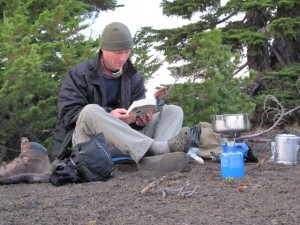 James Alan Gill was born and raised in Southern Illinois in a family of coal miners. He holds an MFA in fiction from Southern Illinois University at Carbondale, and his stories have appeared in several journals and magazines, most recently in Colorado Review and Grain Magazine, and will be forthcoming in Crab Orchard Review's special issue Writing From and About Illinois. He currently lives in Oregon with his wife and two sons, and spends as much time possible sleeping in a tent and hiking trails far from roads, buildings, and groups of people larger than ten.


